What Is Guest Post SEO? Is It Still Worth It?
Yes — guest post SEO is writing an article for another website to reach its audience and earn a backlink, and it is still worth it when the site is relevant, the content is genuinely useful, and the link is editorial — not when it is bought in bulk for links alone.
What Is Guest Posting in SEO?
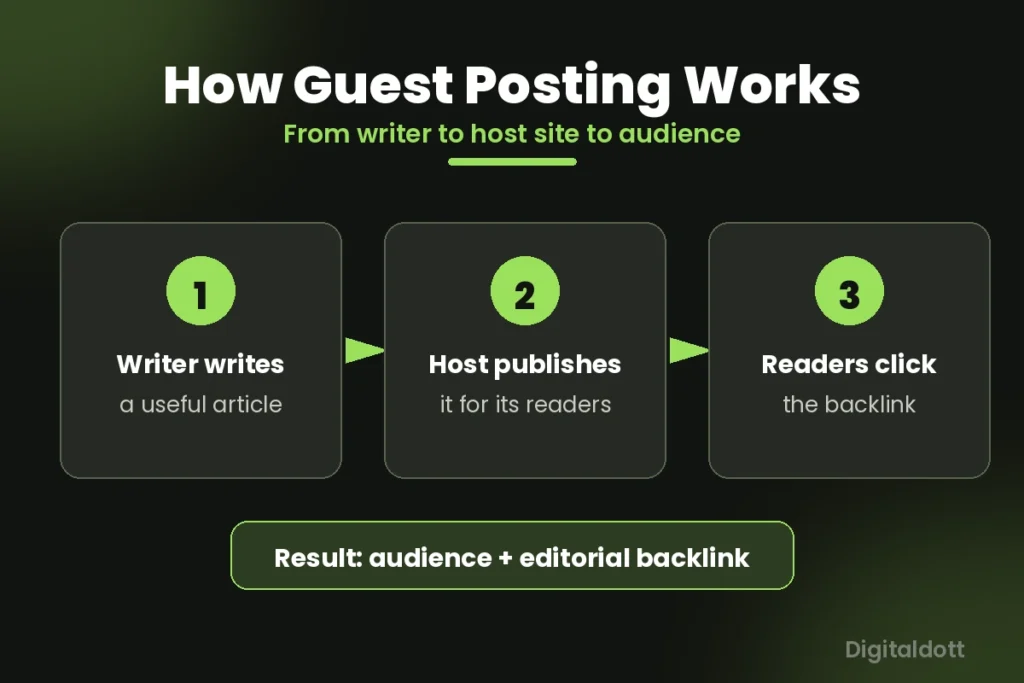
guest posting is when a contributor writes an article for another website and asks the host to publish it there, instead of on their own site. That placement is editorial when the host chooses it because the article helps its readers.
The host platform gains useful content for its audience. The contributor gains a backlink and a chance to be seen as an expert in a niche. The link usually sits inside the article or in the author bio, and it points back to the writer’s own site.
For search engines, that link can act as a signal that another site trusts the writer. Readers who click the link become traffic for the writer’s site, not just a ranking signal. But the signal only helps when the host has real authority and a real audience — a brand cannot buy trust by appearing anywhere. A blogger who writes for a relevant platform is doing guest posting; a writer who spams unrelated sites with thin posts is not doing the same thing, even if the format looks similar.
Think of it as an investment of effort, not a shortcut. The result you should expect is steady growth in ranking and referral visits over time, plus a relationship with an editor who may invite you back. That is long-term value, not a short-term spike.
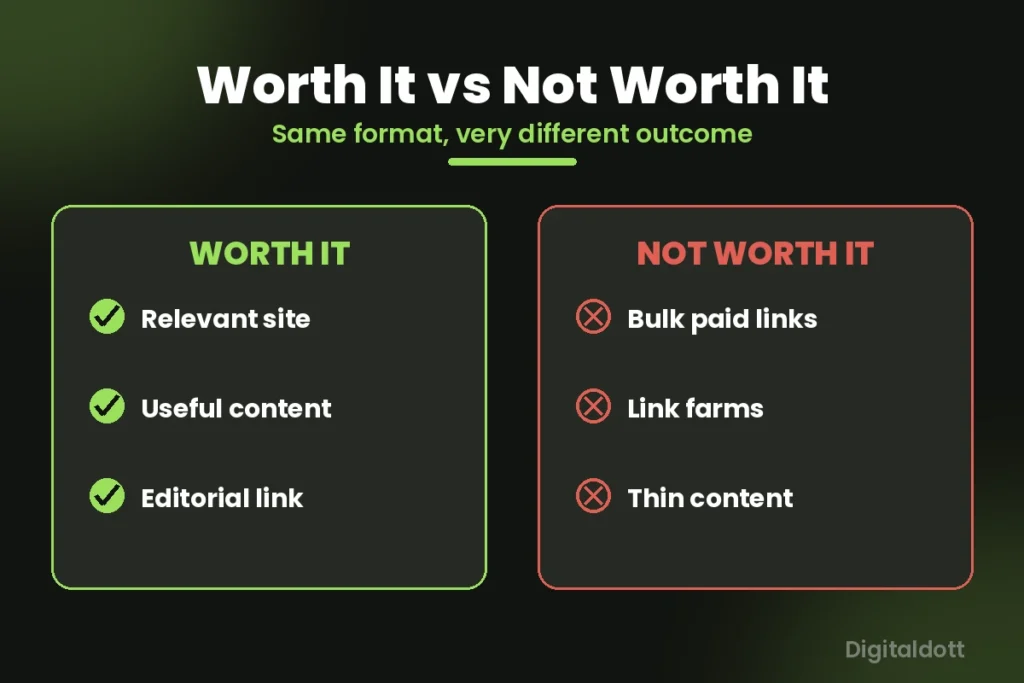
The opposite approach — spammy manipulation through bulk paid links on unrelated sites — is where guest posting stops being worth it. A sustainable plan therefore starts with one relevant site at a time, not with a list of hundreds.
What Benefits Can Guest Posting Bring?
The main benefit is not a single link. It is a set of gains that build on each other, and each one depends on the post being genuinely useful to the host’s readers.
- exposure to new readers and discovery by people who would never find your site alone.
- referral visits from readers who click a link they trust — an endorsement from a host they already follow.
- leads and conversion opportunities when the post solves a real problem for the host’s readers.
- networking, reputation and awareness — a strong post builds confidence in your expertise and recognition as a thought leadership voice.
- promotion through the host’s community and your own followers, plus a useful portfolio piece that shows real engagement with a publication.
Taken together, those benefits explain why the sources keep returning to the same point: guest posting works as branding and as SEO at the same time, but only when the audience, not the link alone, is the target.
When Is Guest Posting NOT Worth It?
It stops being worth it when posts are produced in bulk on cheap sites, especially link farms that exist mainly to sell links. Those sites often publish irrelevant topics side by side, accept every thin, generic article, and show excessive paid posts.
The content itself gives the game away: duplicate or stuffed keywords, shallow advice, repetitive phrasing, and misleading claims. MetaAchievers describes search engines as getting better at spotting unnatural patterns, and low-quality links can lead to penalties in the worst cases, and to lasting damage to trust. Even without a formal penalty, they are often simply ignored.
The work is also wasted when a pitch is ignored or a post faces rejection because it does not fit the host — and risky when harmful anchor patterns are repeated. A post that helps nobody, on a site nobody trusts, is not a bargain at any price.
How Do You Find the Right Guest Posting Sites?
Finding sites is selection, not collection. Start with your niche and your goals, then judge each prospect on its own merits before you pitch anyone.
- Define your niche and audience first, then build a shortlist of prospects — use research, not a random list.
- Check each site’s domain score, metrics and trends — steady traffic, not a sudden drop.
- Use operators such as “write for us” plus your niche, and search directories that list sites accepting posts.
- Study competitors’ backlinks to find sites that already publish in your niche, then do your vetting before you pitch.
- Confirm guidelines, acceptance rules and submission details, and get verification that the site is still active and moderated.
Your outreach should start only after that vetting. filter out sites that accept every topic, publish hundreds of posts a month, or show no real activity. Use clear criteria for every prospect, and keep a shortlist you can defend — a smaller list of relevant sites beats a long list of strangers.
How Do You Pitch and Get Accepted?
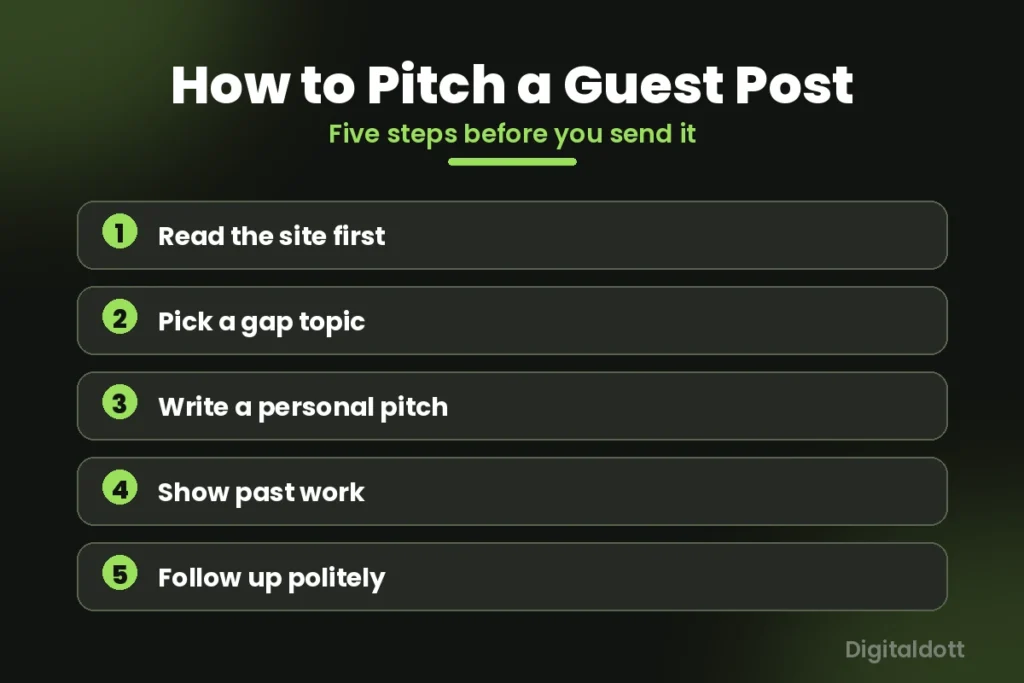
A good pitch is a personalised, concise, professional proposal, not a mass email. Start with a short introduction that shows you read the site, then suggest topics that fill real gaps.
Show examples of past work and brief credentials, and include a short bio that explains why you are a fit. Address the editor by name where possible, and respect their inbox — one clear pitch beats five vague ones. Make the proposal tailored to that site’s readers, not interchangeable between sites.
If there is no response, a polite follow-up after a reasonable interval shows patience and persistence without pressure. timing and courtesy matter: do not chase daily, do not repeat the same message, and accept a no gracefully. A tailored follow-up that adds a new angle is stronger than a copy-paste reminder.
How Do You Write a Guest Post That Ranks?
Write for the host’s readers first, with a clear headline, readable paragraphs and a structure that makes the argument easy to follow. A post that is hard to read will not be shared, linked to, or invited back, however good its keywords are.
Do your research, then write original work with depth and clarity — use statistics and illustrations or other visuals where they help, place keywords naturally, and keep the tone matched to the host. Avoid plagiarism and check grammar before you submit. engaging writing keeps readers on the page; keyword stuffing drives them away.
Then proofread the draft, do a final round of editing for formatting, and add actionable advice and a little storytelling so the post is engaging, not just informative. That combination — useful, original, and easy to read — is what editors accept and readers remember.
Paid Guest Posting vs Organic Outreach
organic outreach means pitching yourself, without paying for placement. It is slower but gives you direct control and ownership of relationships, and it forces you to learn what editors actually want.
paid services and agencies — including a marketplace model, as on Legiit — can be faster and more scalable, but they are often expensive, and cheap bulk offers are the risky end of this market. Paying does not remove the need for relevance, quality, or editorial review.
If you pay, set a clear budget, timeline, expectations and deliverables in advance, and ask about transparency, accountability and reporting. Legiit describes escrow holding payment until a post is live — that kind of protection reduces dependency on trust alone. Check what happens if a placement fails before you commit, not after.
| Aspect | Organic Outreach | Paid Guest Posting |
|---|---|---|
| Cost | Free, except your own time | Paid, and often expensive |
| Speed | Slower | Faster and more scalable |
| Control | Direct control and ownership of relationships | Less direct control; depends on the provider |
| Risk | Lower, when the site is relevant and the link is editorial | Higher with cheap bulk offers |
| Best for | Learning what editors want and building long-term relationships | Scale, when budget, transparency and reporting are set in advance |
How to Choose Sites by Niche
Choose by niche, not by a domain list. Start with the niche that matches your own topic, check whether each site is still accepting posts, and skip anything that does not fit your readers.
Use the organic vs paid comparison in the previous section to decide how to approach each prospect — but niche fit comes first. A site that does not match your topic is not a good prospect, however easy it is to get on it.
Use a shortlist, not a chore list. Start with the niche that matches your own topic, check whether each site is still accepting posts, and skip anything that does not fit your readers. A shortlist is only useful when you treat it as a starting point for your own vetting, not as a set of domains to trust blindly.
duration and frequency depend on the host and your own consistency — one post is a start, not a campaign. After publication, amplification matters: sharing on social channels, replying to comments, and monitoring with analytics.
Use that measurement for improvement: track referral visits, updates to the post, and whether readers engage. Looking to the future, MetaAchievers notes that artificial intelligence tools have summarised web content for users, which makes context, relevance and trust more important, not less.