Introduction
Local Search Engine Optimization is one of the most powerful tools a small business can invest in — but it is also one of the most misunderstood when it comes to timelines. The honest answer is: it depends. But “it depends” is not good enough when you are making a real business decision. So this article breaks it down by industry, competition level, starting point, and the specific type of result you are chasing — so you know exactly what to expect, and when.
So, How Long Does Local SEO Actually Take? (Direct Answer)
For most local businesses, Local SEO results appear in three broad phases: early wins in the first 30–90 days, meaningful local search rankings between 3 and 6 months, and full local search dominance taking 6 to 12+ months. The exact timeline depends on six things: your Google Business Profile status, your review count versus competitors, your NAP consistency across the web, your market size, how competitive your industry is, and your website’s domain history.
Businesses that are starting from scratch in a competitive metro area (like dental SEO or law firm SEO) will take longer than a plumber or electrician in a small town with few competitors. The good news is that the Google Maps local pack — the three-business box at the top of search — can start showing movement in as little as 2 to 8 weeks, even while your website’s organic rankings are still building.
Local SEO Has Two Separate Timelines — Most People Ignore This
One of the biggest reasons business owners get confused about how long Local Business SEO takes is that there are actually two separate clocks running at different speeds, and almost every article on the internet lumps them together into one vague “3 to 6 months” answer.
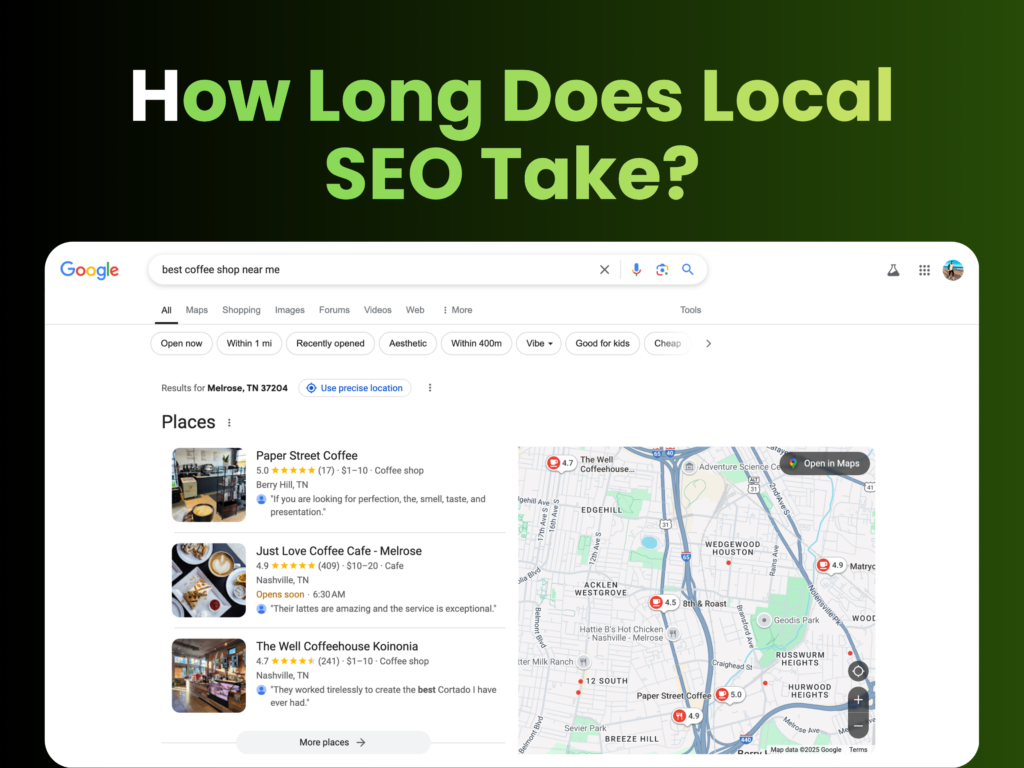
Clock 1 — Google Maps SEO (The Fast Clock): The local 3-pack, also called the Google Maps listing or map pack, has its own ranking algorithm. It rewards your Google Business Profile signals, citation consistency, and review count — all things Google can verify and apply quickly. This clock can show real movement in 2 to 8 weeks for a well-optimized profile in a low-to-medium competition market.
Clock 2 — Organic Website Rankings (The Slow Clock): Your website’s blue-link rankings for local search terms follow the same curve as traditional SEO. According to Ahrefs, only 1.74% of newly published pages reach Google’s top 10 within a year. The average page ranking in position one is over three years old. This clock takes 4 to 12 months minimum, and longer in competitive verticals.
Understanding which clock you are watching is the most important thing you can do before evaluating whether your Local SEO Services are working.
Month-by-Month Local SEO Timeline: What to Expect at Each Stage
Every paragraph in this section answers a specific question business owners ask during each phase of their Local Digital Marketing journey.
Month 1: Foundation and First Signals (Days 1–30)
What happens in the first 30 days of local SEO?
This month is almost entirely about foundations. Your Local SEO Expert or agency will complete a full SEO Audit, fix your Google Business Profile Optimization, correct any NAP Consistency issues across Business Directory Listings, and begin Citation Building. You will not see dramatic ranking movement yet, but your Google Business Profile Insights will start showing more impressions — especially “discovery” impressions, where people find you by service category rather than by name. Watch your GBP data closely this month: impressions and profile views are your leading indicators before any calls come in.
Technical SEO work happens here too.
Your Mobile-Friendly Website check, Page Speed Optimization, Core Web Vitals audit, XML Sitemap submission to Google Search Console, and Robots.txt review all happen in month one. These do not produce instant rankings, but they remove the friction that slows Google down from crawling and indexing your site properly. A site with poor Crawlability can take weeks longer to see any movement compared to a technically clean site.
Months 2–3: Google Maps Starts to Move (Days 31–90)
What results should you see at the 2-to-3-month mark?
This is where the fast clock starts producing. A fully optimized Google Business Listing in a low-to-medium competition market will start appearing in local search results for more search terms. You may see your first map-pack impressions for Near Me Searches like “dentist near me” or “plumber near me.” Call volume from Google Maps typically starts to tick up during this window. Review Management becomes critical here — a steady stream of new Google Reviews during months two and three sends one of the strongest Local Ranking Factors signals to Google.
On-Page Local SEO work accelerates.
Your Location Pages, City Landing Pages, and Service Area Pages are being built and optimized during this phase. These pages target Geo-Targeted SEO keywords like “[service] in [city]” and “[service] near [neighborhood].” Proper Local Keyword Research drives this work — every page should target a specific search intent rather than trying to rank for generic terms. Internal Linking between these pages also begins, helping Google understand the geographic scope of your service area.
Months 3–6: Organic Rankings Climb, Leads Increase (Days 91–180)
When do local businesses start getting consistent leads from SEO?
For most local businesses in medium-competition markets, months three through six is where Local Search Rankings start producing a predictable, measurable stream of organic leads. Your website begins ranking for easier local keywords. Phone calls from Google Maps become consistent rather than sporadic. Local Content Marketing — blog posts targeting hyperlocal topics and neighborhood-specific service questions — starts accumulating organic traffic. This is also the window where Local Link Building begins to compound: guest posts on local publications, citations on niche directories, and mentions from local business associations all add up.
Schema Markup and Local Business Schema start paying off here.
If your SEO strategy included adding proper Local Business Schema markup to your website pages in month one, Google has now had enough time to process it. Schema helps Google understand your business type, service area, hours, and reviews — all factors that influence SERP Visibility for local searches. Many local businesses skip schema entirely, which is one of the most common on-page gaps holding them back from ranking faster.
Months 6–12: Full Local Search Visibility and Domination
How long does it take to dominate local search results in a competitive market?
For businesses in high-competition verticals — Dental SEO, Law Firm SEO, HVAC SEO, Real Estate SEO, and Medical SEO — the 6-to-12-month window is where the investment really pays off. By this stage, your site has accumulated domain trust, your review count has grown steadily, your City Landing Pages are indexed and ranking, and your Google Business Profile has consistent posting, photo updates, and Q&A management. Local Search Visibility compounds dramatically in this phase because Google’s trust in your business signals has built over time — not in one burst.
Online Reputation Management becomes a competitive moat.
At the 6-to-12-month mark, businesses that have consistently managed reviews, responded to every Google Review (positive and negative), and maintained their Business Profile Management are significantly harder for new competitors to overtake. Review velocity and average star rating are among the most powerful ongoing Local Ranking Factors in Google’s algorithm.
Industry-Specific Local SEO Timelines
How long local SEO takes varies dramatically by industry — and no other article explains this properly. A plumber in a small town and a dentist in a major metro are not running the same race. Here is an honest breakdown by vertical:
| Industry | Map Pack Timeline | Organic Ranking Timeline | Why It Takes This Long |
|---|---|---|---|
| Dental SEO | 8–16 weeks | 6–12+ months | High competition, multiple competitors fully optimized, trust signals matter most |
| HVAC SEO | 4–10 weeks | 4–9 months | Seasonal search spikes, large service areas, moderate-to-high competition |
| Plumber SEO | 3–8 weeks | 3–7 months | Emergency search intent favors map pack; competition varies by city size |
| Law Firm SEO | 10–20 weeks | 8–14+ months | Extremely competitive, high-authority incumbents, E-E-A-T signals critical |
| Restaurant SEO | 2–5 weeks | 3–6 months | Fast map pack gains due to proximity weighting; content is simpler |
| Real Estate SEO | 6–12 weeks | 5–10 months | Highly competitive metro markets; city-specific landing pages essential |
| Electrician SEO | 3–8 weeks | 3–7 months | Similar to plumber; emergency intent boosts map pack speed |
| Roofing SEO | 4–10 weeks | 4–8 months | Storm-season spikes; review velocity matters more than most industries |
What Factors Speed Up or Slow Down Your Local SEO Timeline?
What is the single biggest factor in how quickly local SEO works? The starting condition of your Google Business Profile is the most impactful variable for the fast clock. A claimed, fully completed, verified profile with at least 10 recent reviews in a clean GBP Optimization state can see map-pack movement in 2 to 4 weeks. An unclaimed or suspended profile adds weeks before any other work matters.
Here are the five factors that most affect your timeline — and exactly how each one speeds or slows your results:
Google Business Profile Status
An unclaimed profile means zero map-pack visibility until verification clears (which itself takes days to weeks). A claimed but sparse profile — missing categories, services, hours, and photos — leaves ranking signals empty that competitors are filling in. GBP Optimization is always the first, fastest-payoff task in any Local SEO Services engagement.
NAP Consistency Across the Web
Your business Name, Address, and Phone number must match exactly across your website, Google Business Listing, Yelp, Facebook, Apple Maps, Bing Places, and every other Business Directory Listing. Even a difference as small as “Street” vs “St.” across directories creates conflicting signals that slow Google’s ability to trust your business location. Citation Building and cleanup is unglamorous work that produces a disproportionately large impact on map-pack rankings.
Review Count and Velocity vs. Competitors
If the top three businesses in your local 3-pack have 200, 150, and 120 reviews and you have 11, closing that gap is months of consistent Review Management — not a shortcut. According to BrightLocal’s 2025 Local Consumer Review Survey, 83% of consumers use Google to read reviews for local businesses, and 71% regularly read reviews before choosing a local service. Reviews are simultaneously a ranking signal and a conversion signal, making Review Management one of the highest-ROI activities in Location-Based SEO.
Technical SEO Health —
Google cannot rank a website it cannot crawl. Poor Page Speed Optimization, broken Internal Linking, a missing XML Sitemap, or a mis-configured Robots.txt file all slow down the indexing of your Location Pages and City Landing Pages. A proper Technical SEO audit in month one removes these bottlenecks before they compound. Core Web Vitals scores also play a role — Google uses them as a ranking tiebreaker between similarly-optimized local competitors.
Competitive Density and Market Size
A Home Services SEO campaign in a mid-size city with three competitors behaves completely differently from a Dental SEO campaign in a major metro where 40 practices are actively investing in Local Search Marketing. Market size and vertical competitiveness set the ceiling for how fast the fast clock can move, regardless of how well your campaign executes.
The Role of Technical SEO in Your Local Timeline
Does technical SEO really affect how fast local SEO works? Yes — and this is one of the most overlooked factors in Local Business SEO timelines. Most articles about how long local SEO takes focus entirely on Google Business Profile and reviews, ignoring the technical foundation that determines how quickly Google can understand and rank your website.
A Mobile-Friendly Website is non-negotiable — Google uses mobile-first indexing, meaning it evaluates the mobile version of your site first for all rankings, including local ones. If your site loads slowly or breaks on mobile, your Location Pages will underperform regardless of how strong your GBP is. Page Speed Optimization directly affects both your Core Web Vitals scores and your Conversion Rate Optimization — a slow-loading local landing page loses leads even when it ranks.
Schema Markup — specifically Local Business Schema — tells Google structured information about your business type, service area, hours, accepted payments, and aggregate review rating. Businesses without schema are leaving a significant on-page signal empty that competitors may already be filling. Adding schema does not instantly boost rankings, but it helps Google process and trust your business information faster, which shortens the slow clock by weeks or months.
Internal Linking between your Service Area Pages, City Landing Pages, and blog content helps Google understand the geographic scope of your business and the relationship between your services. A plumber with 10 city-specific landing pages that are all properly cross-linked will outrank a plumber with 10 city pages that have no internal linking structure, even with identical off-page signals.

City Landing Pages and Service Area Pages: How Long Until They Rank?
How long does it take for city landing pages and service area pages to rank? New location pages on an established domain typically start receiving impressions within 2 to 4 weeks of indexing. First-page rankings for local keywords take 3 to 6 months on an established site, and 6 to 12 months on a newer domain. The speed depends on the keyword difficulty of the target city — “[service] in [major metro]” is significantly harder than “[service] in [suburb].”
Geo-Specific Content is what separates City Landing Pages that rank from ones that don’t. A page that simply swaps a city name into a template — “[Service] in [City]. We offer [Service] to residents of [City].” — provides no unique value and will not rank. Google has become very good at identifying thin location content. A page that genuinely covers the service area’s neighborhoods, local landmarks, specific customer concerns in that area, and local team information creates the kind of unique Geo-Targeted SEO content that earns rankings.
Hyperlocal SEO takes this further. Neighborhood SEO targets search terms at the suburb or district level — “[service] in [neighborhood name]” — which often has lower competition and faster ranking timelines than city-level terms. For businesses serving multiple districts within a single city, a Hyperlocal SEO strategy targeting individual neighborhoods can produce faster wins while the main city pages are still building authority.
Can You Speed Up Local SEO? What Actually Works
What can you do right now to speed up your local SEO results? Some tasks have a disproportionately large impact on how quickly Google responds to your Local Search Marketing efforts. Here are the highest-leverage actions, ranked by speed of impact:
- Complete every section of your Google Business Profile today. Primary and secondary categories, services with descriptions, business hours, photos (exterior, interior, team, products), business description with your top keywords, and Q&A responses. This is the single fastest-moving, highest-return action in all of Local SEO.
- Fix NAP Consistency across the top 10 directories this week. Google, Yelp, Facebook, Apple Maps, Bing Places, Yellow Pages, Foursquare, Angi, BBB, and your industry-specific directories. Mismatches here create drag that no amount of content can overcome.
- Start a consistent review request system immediately. Send a Google Review link to your last 20 customers. Set up a system so every new customer gets a review request within 24 hours of their service. Consistent review velocity is one of the most powerful ongoing Local Ranking Factors.
- Submit your sitemap to Google Search Console. If it is not submitted, Google is finding your pages by crawling rather than by your direction — which is slower. A proper XML Sitemap submission can accelerate indexing of new Location Pages by weeks.
- Publish one hyper-local blog post this month. A post answering a genuine local question (“When should [city] homeowners schedule HVAC maintenance?”) builds Local Content Marketing momentum and targets long-tail local keywords that accumulate organic traffic over time.
- Run a technical SEO audit on your website. Use Google PageSpeed Insights (free) to check your Core Web Vitals. Fix any mobile usability errors in Google Search Console. Add Local Business Schema to your homepage and location pages if it is not already there.
How to Measure Whether Your Local SEO Is Working
What are the right metrics to track for local SEO progress? Most business owners track keyword rankings, which is the slowest and least actionable metric available. Here is what actually tells you whether your Local Search Visibility is improving:
Leading indicators (weeks 1–8): Google Business Profile impressions (total and discovery), profile views, direction requests, and phone call clicks directly from the GBP. An increase in “discovery” searches — where people find you by service type, not your business name — is one of the earliest and most reliable signals that your GBP Optimization is working.
Mid-stage indicators (months 2–4): Website traffic from organic local search (visible in Google Analytics, filtered by location), impressions for local keywords in Google Search Console, and phone call volume month-over-month. A consistent upward trend in these numbers — even before you are ranking in the top three — tells you the campaign is working.
Revenue-stage indicators (months 4–12+): New patient or new customer acquisition from organic channels, cost per local lead compared to paid ads, and Local Business Growth in appointment bookings or service requests. This is the metric that actually justifies continued investment in Local SEO Services.
When to worry: If your GBP impressions are flat at 90 days of consistent, competent work — not just bouncing around normal week-to-week variation but genuinely not growing — something structural is wrong. Common culprits: a verification issue, a suspended profile, a NAP mismatch confusing Google, or a profile in a category that does not match your actual services.
Frequently Asked Questions About Local SEO Timelines
Is local SEO faster than national SEO? Yes, in most cases — and the reason is mechanical. Local SEO benefits from proximity as an instant ranking factor (Google applies distance to the searcher in real time), a separate map-pack algorithm that rewards off-site signals Google can verify quickly, and a smaller competitive field. A national SEO campaign competes against every business in the country for the same keyword. A Local Business SEO campaign competes against the handful of businesses within a few miles. The bar is lower, the proximity lever exists, and the map pack gives you a second ranking surface that national SEO never gets.
Can local SEO show results in one month? Sometimes, on the fast clock only. A fully verified, well-optimized Google Business Profile in a low-competition market can start generating map-pack impressions and the first phone calls within 2 to 4 weeks. Organic website rankings for local keywords will not move meaningfully in 30 days on any domain. If a Local SEO Agency promises full local domination in 30 days, treat it as a serious red flag.
How long does it take to rank in the Google Maps 3-pack? In a low-to-medium competition market with a clean, verified profile, 2 to 8 weeks is realistic for first visibility. Cracking the top three in a competitive vertical like Dental SEO or Law Firm SEO in a major metro can take 8 to 16 weeks or longer, even with a strong campaign.
What if I’ve done local SEO for 6 months and still see no results? First, audit the fundamentals: is your GBP verified and fully complete? Do you have NAP Consistency across major directories? Do you have recent reviews? Have your Location Pages been indexed in Google Search Console? Are there any technical crawlability issues? Most 6-month no-result situations trace back to one of these fundamentals being missed rather than a failure of the SEO strategy itself.
How long does it take for Google Business Profile optimization to show results? GBP improvements are the fastest-moving signals in all of Local Search Marketing. A complete profile with accurate categories, photos, services, and a consistent stream of reviews can start producing more impressions within 1 to 3 weeks of optimization. This is the most important first step in any Local SEO for Small Business engagement.
Does paying more for Local SEO Services make it faster? Higher budget generally allows more simultaneous work — more city landing pages built at once, more aggressive Citation Building, more Local Link Building outreach — which does compress the timeline. But no budget can make Google trust a brand-new domain faster than it naturally would. The map-pack fast clock responds to effort; the slow clock (organic rankings) responds partly to time itself.
The Realistic Expectations Summary: Local SEO Timeline by Scenario
| Scenario | Map Pack Visibility | Website Rankings | First Consistent Leads |
|---|---|---|---|
| New GBP, small town, low competition | 2–6 weeks | 3–5 months | Months 2–3 |
| Claimed but neglected GBP, mid-size city | 3–8 weeks | 4–7 months | Months 3–4 |
| Established site, medium competition | 2–5 weeks | 3–6 months | Months 2–4 |
| Competitive metro (Dental/Legal/HVAC) | 8–16 weeks | 6–12+ months | Months 4–6 |
| Brand-new website, no domain history | 4–10 weeks (GBP-led) | 8–14+ months | Months 3–5 |
| DIY with consistent effort, low competition | 4–10 weeks | 4–8 months | Months 3–5 |
Final Word: Local SEO Is a Compounding Asset, Not a Monthly Expense
Every business owner eventually asks whether local SEO is worth the wait. The answer is yes — but only if you understand what you are buying. Local SEO is not a monthly service you pay for and consume like advertising. It is a compounding asset. The City Landing Pages you build in month two are still ranking in month 24. The reviews you earn in month three make your profile more competitive in month 18. The Local Link Building you do in month four raises the domain authority that makes every future page rank faster.
Compare this to paid search: the moment you stop paying for Google Ads, your visibility disappears. Local SEO, once established, continues to Increase Local Traffic and Generate Local Leads even when you scale back investment. That is the fundamental reason that businesses serious about Local Business Growth treat Local Digital Marketing — and specifically Local Search Engine Optimization — as a long-term investment rather than a short-term tactic.
The first 90 days feel slow. Months three through six feel like progress. After 12 months of consistent effort, the compound interest of Local SEO is one of the most reliable sources of new customer calls a local business can have.
How much does a professional website design cost?
Web design costs vary depending on the platform, complexity, number of pages, and functionality required. We offer transparent, fixed-price packages for most project types. Contact us for a free quote and we will give you a clear breakdown of costs with no hidden fees.
How long does a web design project take?
Most projects are completed within three to six weeks. A simple Squarespace or Webflow site can be ready in two to three weeks while a complex WordPress or Shopify build with custom functionality typically takes four to six weeks. We always provide a clear project timeline before starting.
Will my website be optimised for mobile?
Absolutely. Every website we build is fully responsive and tested across all major devices and screen sizes — desktop, tablet, and mobile. Mobile optimisation is not an optional extra for us — it is a standard part of every build.
Do you provide website maintenance after launch?
Yes. We offer ongoing website maintenance and support packages covering security updates, plugin management, content updates, performance monitoring, and technical fixes. Ask us about our maintenance plans when you get in touch.