
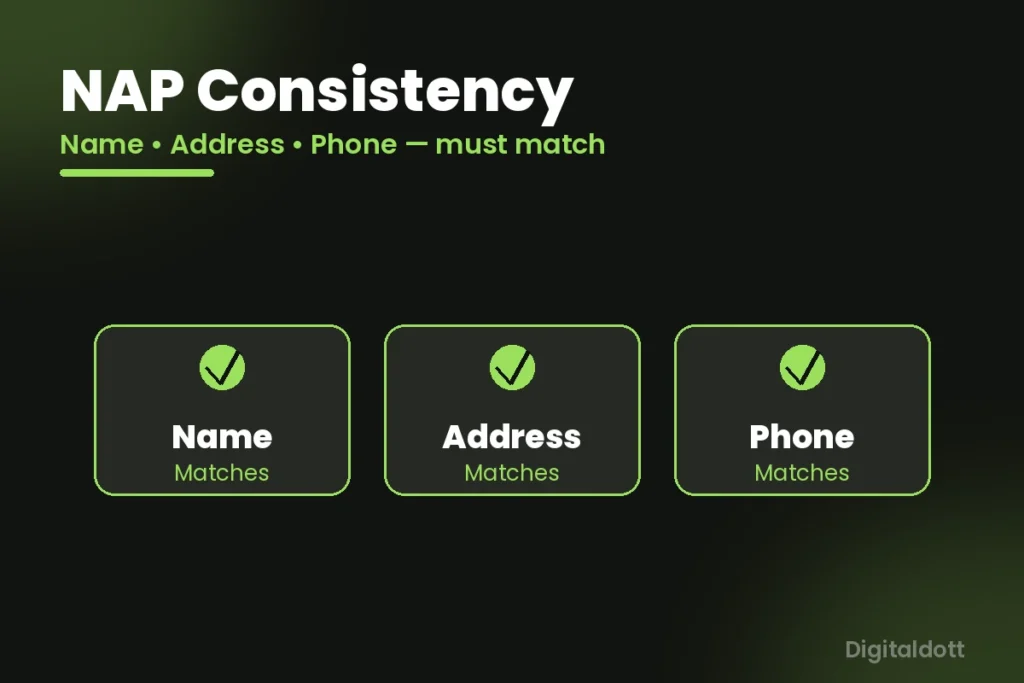
What is NAP consistency? Why Name, Address, and Phone Must Match
NAP consistency means your business name, address and phone number match exactly and stay identical everywhere they appear online.
That is the whole rule in one sentence, and it is stricter than most businesses expect.
A uniform format is the goal: one official version, written the same way on listings, profiles and places across the web.
When sources are in agreement, Google can tie them to one business.
When they are in conflict, even a small difference in details breaks the matching picture, and the business becomes harder to recognise.
So consistent details are not paperwork for its own sake; they are how a business proves it is one real business, in one place, at one number. Wherever your business appears online, the version should be the same.
What Does NAP Stand For in Local SEO?
NAP is an acronym that stands for Name, Address and Phone: the three identifiers Google uses to recognise a local business.
Think of them as a fingerprint: three points of contact information that, together, validate that a business is legitimate.
This is more than simple data entry.
The signal matters because search engines read the same basic details across many sources, and agreement builds credibility and authority.
That discovery signal is critical and powerful: it can influence rankings, because a business Google can verify is a business Google can show with confidence.
In short, NAP is the minimum proof of identity that local search runs on.
Why Does NAP Consistency Matter for Google and AI?
Google organises knowledge in an entity: a person, a company or a place, held together by agreeing records.
When all records agree, the entity stays sharp; when they contradict each other, it blurs.
Prominence is part of that judgement, and every consistent mention adds to the votes for your profile.
Consistent mentions build confidence, while conflicting ones create doubt about which records belong to you.
That is why recognition fails quietly: Google and AI assistants make the same comparison of what they already hold, then connect and tie a name, a location and a number to one business — or they do not. To verify that business, they need the records to agree.
Asked to recommend a business nearby, an assistant names a handful and answers from the records it trusts most.
A business whose records disagree is easy to leave off, and Google is left guessing between an old number, a second branch and another business entirely.
The knowledge graph behind those answers works the same way: agreement sharpens it, disagreement blurs it.
Where Do NAP Mismatches Usually Appear?
Mismatches build up through ordinary business events: a move, a new number, or a name change.
Listings you know about get updated, and the rest keep what they copied, so old, outdated and previous details live on.
The patterns are recognisable. Moves leave a moved address behind, and a forgotten directory keeps the previous shop.
A second phone number stays live after the first is cancelled, and changes to the trading name create variations between the shopfront name, the legal name and a shortened form.
A suite number in some places and a unit number missing in others reads as two addresses, not one.
Abbreviated or misspelled names add another split, and duplicate listings — and duplicates of a profile at an old address — split reviews as well as identity.
| Mismatch type | Example | What it looks like |
|---|---|---|
| Old address | Previous premises still listed after a move | Two locations for one business |
| Old or second phone | Cancelled landline still on directories | Calls that go unanswered |
| Name variation | Shopfront, legal and shortened names all live | Two or three businesses, not one |
| Unit number | Suite shown in some places, missing in others | Two different addresses |
| Duplicate listing | Old profile at a previous address never removed | Split reviews and split identity |
One wrong detail repeated from a shared source is the quietest pattern of all, because a single bad entry reaches every site that copies it.
How Does NAP Affect Rankings, the Map Pack and Customers?
NAP affects visibility because Google uses matching details to decide whether a business deserves a pack place.
The Map Pack — the three top results on Google Maps and just below ads — gets 44% of local clicks, often before users scroll to organic listings, per SeeResponse.
That is prime territory, and spots in it go to businesses Google can verify.
Positions are not guaranteed by consistency alone, but inconsistency can cost them: a listing may be deprioritized, or removed from valuable results entirely.
For customers, the cost is practical. Traffic that should become foot visits and conversions leaks away instead.
A wrong number means calls that go unanswered, and a wrong address in a plaza with forty offices sends people to the wrong floor.
A customer who tries once and gets no answer will not try again, so the customer who should arrive never does, and the visit is lost.
That erosion of trust shows up in impressions too: a business that cannot be verified looks less reliable.
SeeResponse reports a mid-sized plumbing business in Austin with discrepancies across 12 major platforms that, after cleanup, jumped into the Map Pack within six weeks, with phone inquiries up 48%, Map Pack impressions up 63%, and review ratings rising from 3.7 to 4.3 stars after profiles were merged.
That is that source’s example, not a guaranteed result, and it still makes the point: clean details let rankings, reviews and visits work together.
What Does Google Require for Your Name, Address and Phone?
Google’s guidelines require the real business name, used consistently, and a real, precise address.
The name must carry no slogans, phone, website, hours, services or location, and categories should be as few and as specific as possible.
Hours matter too: regular hours plus special hours for holidays, kept current wherever they are shown.
The address must be real and precise: no PO boxes and no virtual offices.
A business operating from a residence should hide the address and define a service-area instead, so customers see the area served rather than a home address.
Adding services or a location to the profile name can lead to suspension, so the name on the profile must be the name customers actually know.
These rules are not decoration. In an appeal, Google compares evidence with the profile, so company documents should reflect the same name, address and phone as the listing.
How Do You Choose One Official NAP Version?
Start with the official name, the real business name customers actually know.
Choose one version and use it everywhere, every time.
Small format differences are usually understood, but one official form, used everywhere, is the safest regular practice.
Settle abbreviations once and apply them the same way in every place.
If a street name is spelled out in full in one place and abbreviated elsewhere, the two read as different addresses, so pick the full form or the abbreviated form and hold to it.
The number is simpler to settle: choose one primary number for the business and use it across the web.
Then write the chosen name, address and phone into a single source-of-truth document, so every team member, vendor and marketer copies from the same page.
How Do You Audit NAP Across the Web?
An audit starts with the profile itself, the most important listing.
From there, check the website footer, contact page, and social profiles, then the directories and the sites that collect data — aggregators and data providers that feed many others.
Search for the business name and city together, and note every variant you find.
Monitor continuously: a single source-of-truth document is only useful if it is checked, because new profiles and new copies appear all the time.
Review every place you found, and mark what matches, what is wrong, and what needs a claim, a correction or a removal.
| Place to check | Type | Priority |
|---|---|---|
| Google Business Profile | Core profile | First |
| Business website (footer, contact page) | Owned | First |
| Social profiles | Owned | First |
| Major directories | Directory | Next |
| Data aggregators | Data provider | Next |
| Industry-specific sites | Niche directory | Then |
Then fix what is wrong, starting with the profile and the website, and check the work afterwards: a correction that has not been checked is only half a correction.
How Do You Fix NAP Errors and Keep Them Fixed?
A correction counts only once it is verified. Google reviews profile edits for identity issues: usually 10 minutes, but up to 30 days if documents are needed.
So the fix process is not just edit and forget; it is edit, verify, and confirm the corrected details actually show live.
Start with the profile and the website, then work outwards to directories, starting with the influential sites that feed others — the aggregators.
Keep a record of every listing, its login and its last correction date, so the next audit does not start from scratch.
If a listing cannot be claimed, escalate it: ask the directory’s support, and refuse to leave a wrong profile live without a request for removal.
- Verify your Google Business Profile, and confirm the corrected details actually show live.
- Edit the profile and the website first, then work outwards to the influential sites that feed others.
- Claim or report the other listings, starting with those that show up for your business name.
- Request removal of duplicate listings, and mark old profiles as moved or closed.
- Keep a record of every listing, its login and its last correction date.
When Should You Update NAP, and What If You Move or Change Phone?
Update everywhere the moment a detail changes, starting with the profile and the website, then every directory after them.
When you are relocating or taking a new number, do not leave the old details live while the new ones settle in.
Company paperwork should reflect the new data too, because in an appeal Google will compare the evidence with the profile.
A business that moves to a new address after being verified has to verify again, so treat verification as part of the move, not an afterthought.
That change is also the moment most mismatches are born, so it is the moment to keep the audit habit tightest.
- Run a quarterly audit, and put it on the marketing calendar as a regular routine.
- Assign one owner for NAP data, so accountability is clear and updates are not left to everyone and no one.
- Keep one source-of-truth document, shared with your team, vendors and marketers, and refresh it under a single update policy.
A quarterly check, one assigned owner, and one shared policy turn consistency from a crisis response into a routine.
Small format differences are usually understood, but the safest regular practice is still one official form, used everywhere, every time.